Is a Degree Worth It? I Built a Free Calculator to Check
Almost a decade ago I started to reconsider what seemed to have an obvious answer: the economics of a university education. This turned into a book, Is Going to Uni Worth It?, and the motivation for it was to help young people think through an increasingly expensive decision.
The TLDR of the book is that university is worth it in some cases but in other situations, the alternatives (e.g. an apprenticeship or vocational path) are better. Returns on higher education depend on a variety of factors, not least the fact that what you study and where you go for that education makes a difference.
With that in mind I built a tool that brings to life the financial element of a degree and what it could be worth over a lifetime.
What the tool does
Is Uni Worth It? allows you to pick a subject and compare universities by estimated lifetime financial return.
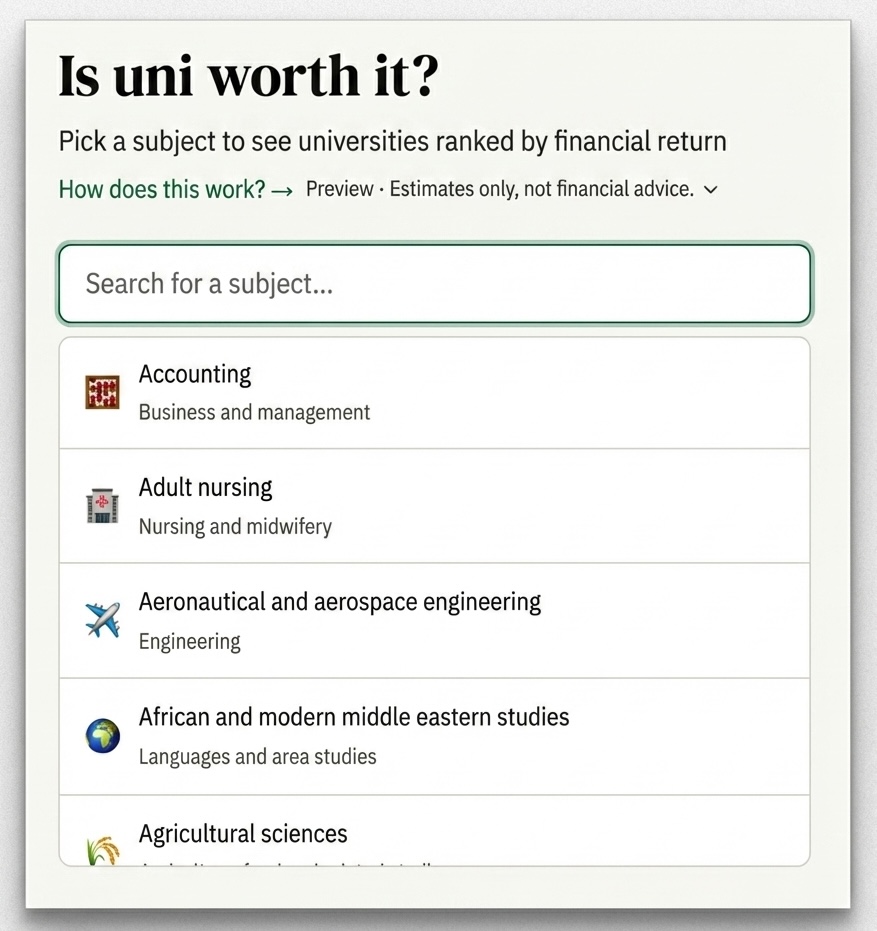
In simple terms, it estimates how much more, or less, you’re likely to earn over a working life by taking a degree instead of skipping university, once student loan repayments are taken into account.
The tool currently has over 150 subjects across 300+ universities, drawing on roughly 3,000 provider-level earnings entries under the hood. Where provider-level earnings aren’t available for a subject, it uses national subject averages.
For earnings figures, I used the government’s LEO dataset, which links education records to HMRC tax data. The live rankings are currently shown on a Plan 5 student loan basis using an average maintenance loan, with everything adjusted to January 2026 prices.
One worked example
The key number in the app is the net financial return. To get this, we do the following:
net return = lifetime earnings on the degree path
           - lifetime loan repayments
           - lifetime earnings on the non-university path
For example, Accounting at Bath currently comes out as follows:
| Step | Figure |
|---|---|
| Observed earnings points used by the model (years 1, 3, 5) | £37,702 / £48,784 / £68,232 |
| Estimated lifetime earnings on the degree path | ~£5.20m |
| Less lifetime student loan repayments | ~£53k |
| Net university path after repayments | ~£5.15m |
| Estimated lifetime earnings if you don’t enter higher education | ~£1.48m |
| Estimated net return of the degree | ~+£3.66m |
That final number is the headline figure. It represents the extra lifetime cash the model estimates from the degree path compared with the alternative, after loan repayments.
The net return compares the degree path with a non-university benchmark based on LEO post-16 earnings data for people who did not enter higher education. That benchmark covers a mixed population and may include some non-HE routes such as further education or apprenticeship participation, so it isn’t a pure “straight to work, no further training” figure.
That caveat matters, but I still think this broad comparison is a good place to start given the limits of available data.
How I built it
I had a rough idea of what data sets to use given the research i undertook when writing the book on the topic, but I also prompted Codex and Claude to undertake several websearches to find the most useful data.
The main inputs came from:
- DfE LEO for graduate earnings
- LEO post-16 outcomes for the non-university baseline
- HESA enrolment data to work out which universities actually offer which subjects
- Further Education Outcomes for a benchmark Level 6 apprenticeship comparison
- ONS inflation data and current student loan rules to put everything on a like-for-like basis
Codex was especially helpful on the backend and data side. It helped me pull together awkward government files, wrote the transformation pipeline, and turned that into something the app could query quickly.
Claude Code on the other hand was more useful on the frontend. It turned what could have been a dry spreadsheet-on-a-page into something more usable. The front-end design skill helped a lot here but you also have to be “tasteful” in deciding the final design and experience.
Tech stack and trade-offs
The app is built in Next.js, all in TypeScript, and deployed on Vercel.
I wanted one setup that could handle the user interface, API routes, shareable result pages, and deployment without complexity and Next.js plus Verel makes that easy.
Another optimisation decision was to convert the raw government CSV source files into generated JSON before runtime. The raw files are about 2.7gb in total. The runtime JSON the app needs is under 1mb. That means the live app doesn’t need a database and doesn’t have to parse giant CSVs on demand.
The trade-off is that refreshing the data is a manual build step rather than something automatic. However, for a short side project this felt like the right compromise.
Why build it?
Admittedly, looking at just the financial returns of a degree doesn’t capture everything that matters about higher education. There’s personal growth, and the friends and networks you build while at uni. However, the financial question is real too, and people should be able to consider the numbers before taking on a meaningful amount of student debt that will take many years to repay.
Try it
The calculator is free at Is Uni Worth It?.
Pick a subject, find your university, and see the numbers.
If something looks off, or you think I’ve missed something, there’s a feedback form where you can share what you found.